
Welcome to the ghastly history of London’s execution sites. These were places where Londoners were not simply put to death, but where the city turned death into a public event. Some were established execution grounds; others were ordinary streets, market squares, commons and riverside locations that acquired a gruesome reputation over time. For centuries, executions were staged as a warning to the living, with the condemned paraded through the streets and crowds gathering to watch them die.
This chronological journey through the changing geography of the capital punishment will take you from the medieval gallows of Tyburn and the religious burnings of Smithfield to the spectacular hangings of the Georgian capital, the Victorian crowds outside Newgate and, finally, the prison walls that concealed London’s last executions. All of these locations can still be visited today, preferably on a bleak November afternoon. The gallows are long gone, but the ground beneath them has not exactly forgotten its history.
In the Shadow of the Tyburn Tree
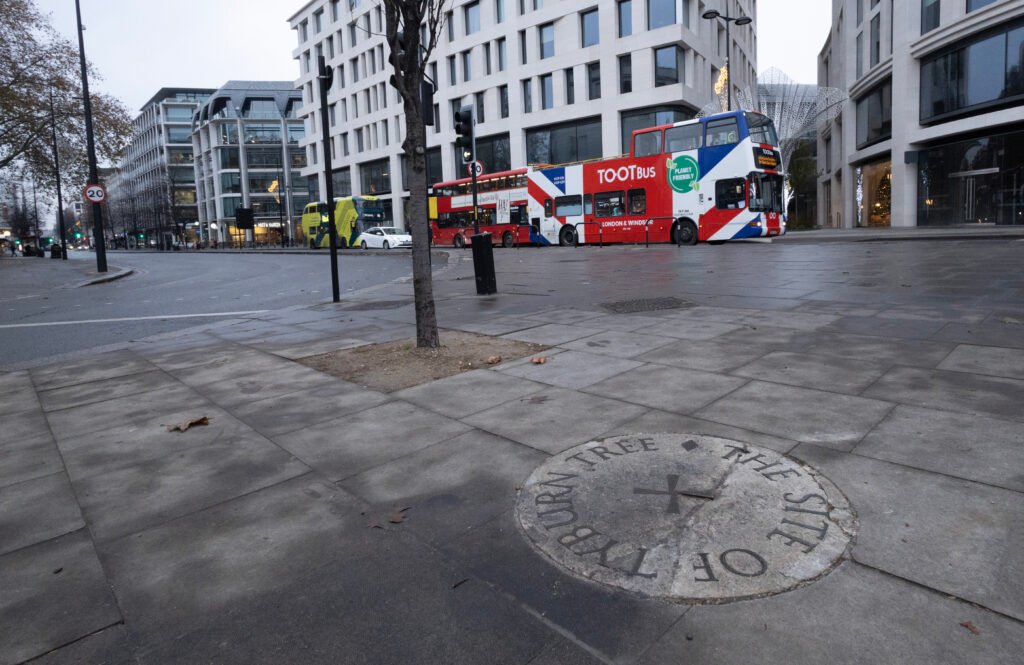
The area around today’s Marble Arch, now part of London’s busy shopping and tourist district, was once open countryside, approximately five kilometres from the old city walls. From its first recorded execution in 1196 until its final use in 1783, the gallows at Tyburn ranked among Britain’s most recognisable execution grounds. For centuries, it was also one of London’s most recognisable landmarks, known to inhabitants of the capital almost as well as St Paul’s Cathedral or the Tower of London.
The first recorded execution at Tyburn took place in 1196, when William FitzOsbert, also known as William Longbeard, was put to death. A popular agitator who had led opposition to the authorities and their taxation policies, he was captured after taking refuge in a church and subsequently executed at Tyburn.
The journey to the gallows was part of the punishment. Condemned prisoners were taken from Newgate to Tyburn in an open cart, travelling along a route that became known as the Tyburn Road. They passed through streets filled with thousands of curious spectators, mingling with street vendors selling food and drink, prostitutes and pickpockets who took advantage of the distracted crowd. The journey could take several hours, depending on the number of onlookers and the stops along the way. Some prisoners drank as they travelled; others addressed the public, made speeches or delivered their final confessions.
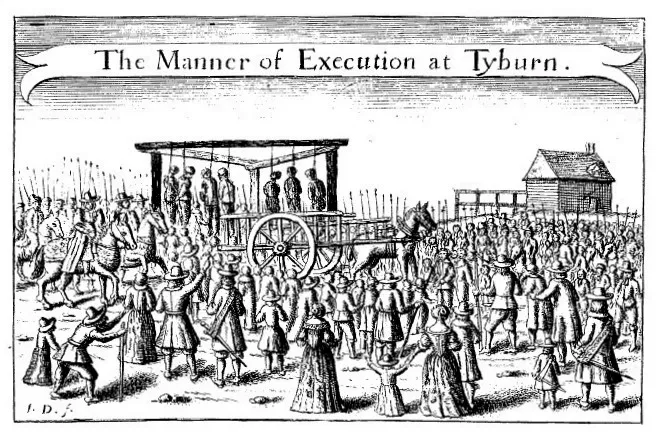
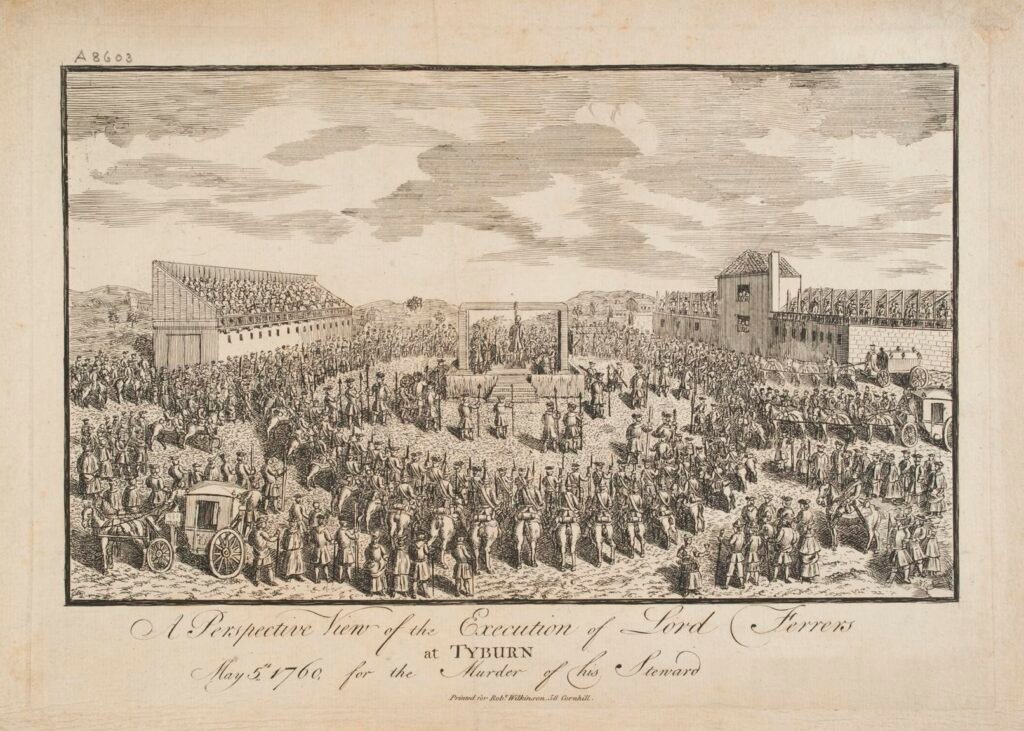
Those watching could be either supportive or cruel towards the condemned, depending on the nature of the crime and the prisoner’s attitude. Spectators were also prepared to pay handsomely for a good view. Samuel Pepys himself recorded paying a whole shilling to stand on a cartwheel to watch an execution in Leadenhall Street in 1663. By the eighteenth century, people were charging for seats and viewing positions, and one woman, known as Mother Proctor, apparently operated a particularly lucrative viewing platform at Tyburn. It was, in its own way, an early form of event ticketing. The entertainment was just considerably less family-friendly.
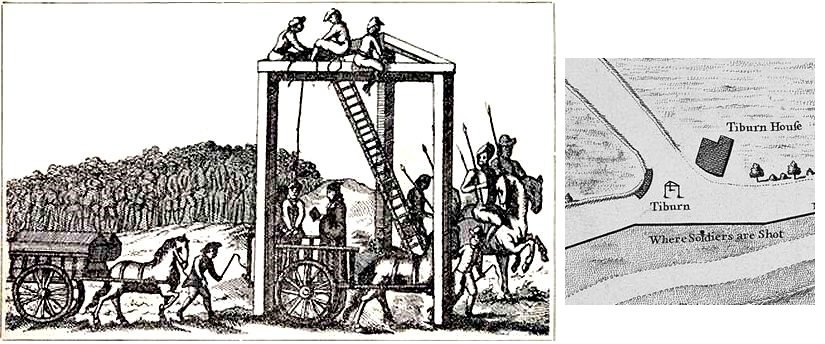
In 1571, the traditional gallows were replaced by a new triangular structure, known as the Tyburn Tree. It became so recognisable that a miniature representation appear on old maps of London. The structure could accommodate as many as 24 condemned people at once. In 1759, however, the famous triangular gallows were dismantled and replaced by portable gallows, which were brought out when required. The iconic Tyburn Tree had therefore disappeared more than twenty years before the final execution at the site.
By the late eighteenth century, the area around Tyburn was undergoing substantial development. As Marble Arch became increasingly desirable for residential development, the traditional procession and the vast crowds it attracted were becoming an increasingly inconvenient feature of a changing city. The final execution at Tyburn took place on 7 November 1783, when John Austin was hanged. The principal place of public execution was subsequently moved to Newgate Prison.
Smithfield’s Fires of Faith
Around the twelfth century, Smithfield was a large, relatively flat open space just outside London’s city walls. It became an important location for markets, including the trading of horses and other livestock, as well as a gathering place for fairs and public events. Today, however, the area is perhaps more closely associated with its bloody history of executions than with its former markets.
Smithfield was not one single, consistently used execution ground. The wider area included several open spaces, among them a place known as the Elms. These locations witnessed numerous bloody events, including the execution of William Wallace in 1305. Wallace, a Scottish resistance leader, had been convicted of high treason and subjected to the full punishment reserved for traitors: he was dragged, hanged, disembowelled, castrated, beheaded and quartered. His head was displayed on London Bridge, while parts of his body were sent across the kingdom as a subtle form of public messaging.
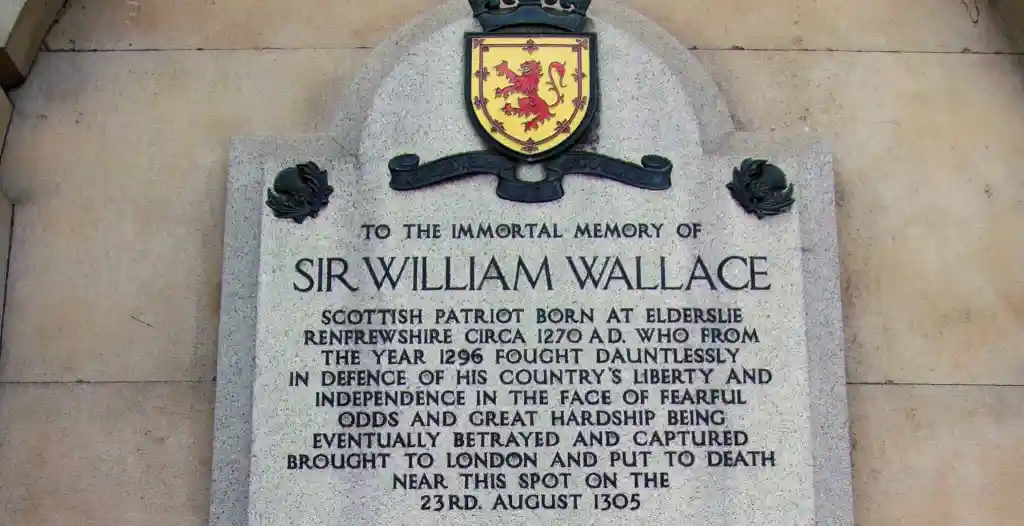
Smithfield reached the height of its notoriety as a place of execution during the religious upheavals of the fifteenth and sixteenth centuries. Lollards and Protestants were among those persecuted there, while religious repression elsewhere in the country also turned against Catholics when the balance of power shifted. Many of those convicted of heresy were burned at the stake. In 1401, William Sawtrey became the first person executed under the statute allowing heretics to be burned. Later, during the reign of Mary I, Smithfield became one of the principal locations for the persecution of Protestants. The London Museum estimates that 48 people were burned there over just three years of Mary’s reign.
John Rogers was the first Protestant martyr burned under Queen Mary I, on 4 February 1555. He was a clergyman and Bible editor, and an account of his final moments was later included in John Foxe’s Book of Martyrs. According to this account, Rogers was reportedly offered the opportunity to see his loved ones before his execution. His wife and children were present to witness his death. The book makes for remarkably sombre reading.

The importance of Smithfield as a place of religious execution gradually declined as heresy prosecutions diminished following the Reformation. The executions did not stop immediately with the death of Mary I, however, and Smithfield’s religious history is longer and more complicated than its popular association with Bloody Mary might suggest.
The area’s gruesome past has also inspired local ghost stories. Some accounts claim that, on dark nights, people have heard the cries and screams of those burned alive for their beliefs, sometimes accompanied by the smell of burning flesh. These stories belong to London’s folklore rather than documented history, but they have become part of the macabre reputation of the former execution ground. It is perhaps not the first place one would choose for a peaceful evening stroll, unless one deliberately seeks out the macabre.
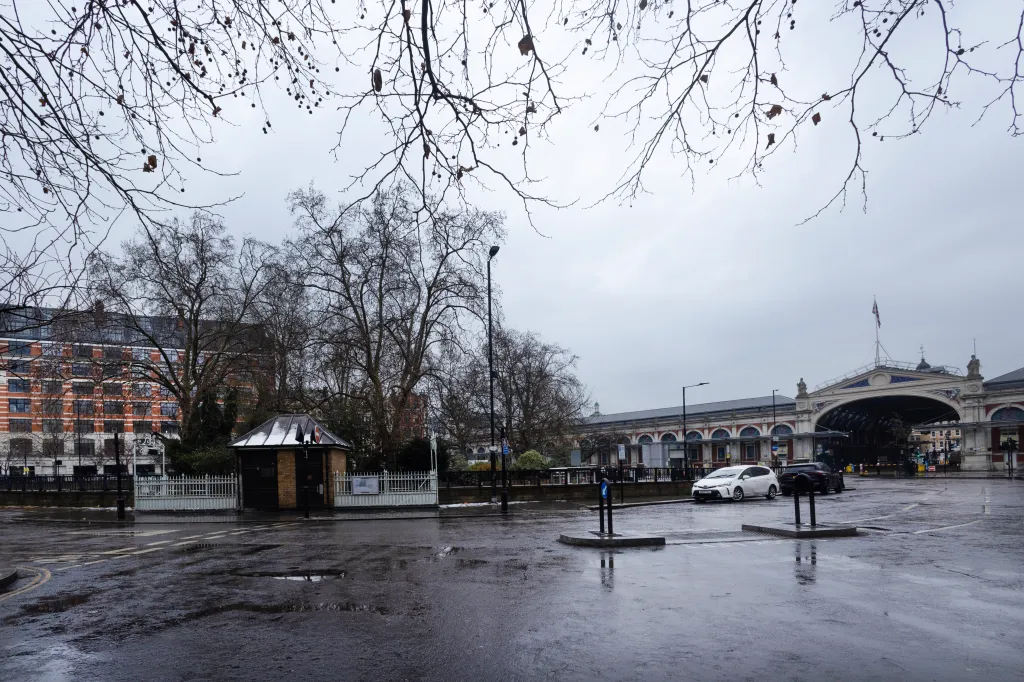
Heads on Tower Hill
Tower Hill was one of London’s best-known places for executions by beheading. Around 125 people are estimated to have been executed there between the late fourteenth and eighteenth centuries. Although this number seems relatively low compared with other sites in London, many of those condemned were members of the upper classes, whose executions drew considerable public interest. Tower Hill was therefore associated less with mass executions than with the downfall of prominent political and religious figures.
Some of the earliest high-profile beheadings associated with Tower Hill took place in 1381, during the Peasants’ Revolt. Rebels led by Wat Tyler entered the capital and broke into the Tower of London, dragging Simon Sudbury, Archbishop of Canterbury, and Robert Hales, the Lord Treasurer, out of the fortress. Both men were beheaded on Tower Hill, and their heads were subsequently displayed on London Bridge. The first official execution recorded at Tower Hill took place in 1388, when Sir Simon de Burley was put to death.

Tower Hill witnessed the last public beheading in Britain. Simon Fraser, Lord Lovat, was executed there on 9 April 1747 following his conviction for treason after the Jacobite rising of 1745. His demise attracted such a huge crowd that a viewing stand collapsed, killing several spectators. Even the seemingly innocent onlookers were not entirely safe. One could turn up to watch an execution and find oneself unexpectedly involved in the entertainment.
The last executions at Tower Hill took place in 1780, when three people involved in the Gordon Riots were hanged there, including two women, Charlotte Gardiner and Mary Roberts.
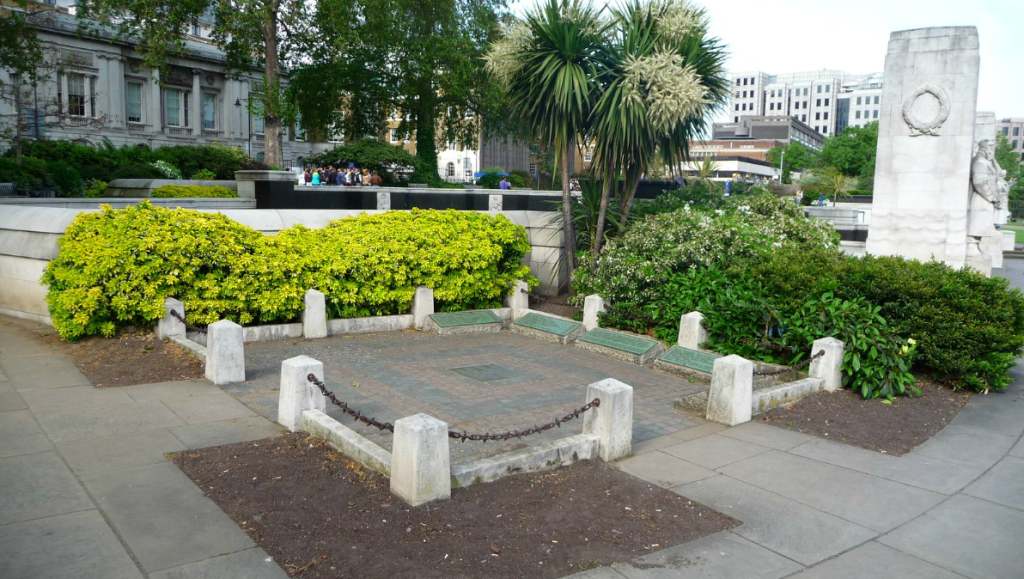
Within the Tower Walls
Tower Hill was London’s public execution ground, but a small number of people were killed inside the Tower of London itself, away from the crowds. Tower Green was used for executions reserved for people of high rank or particular political importance. The best-known people who died there included Anne Boleyn, Lady Jane Grey, Catherine Howard and Margaret Pole, Countess of Salisbury.
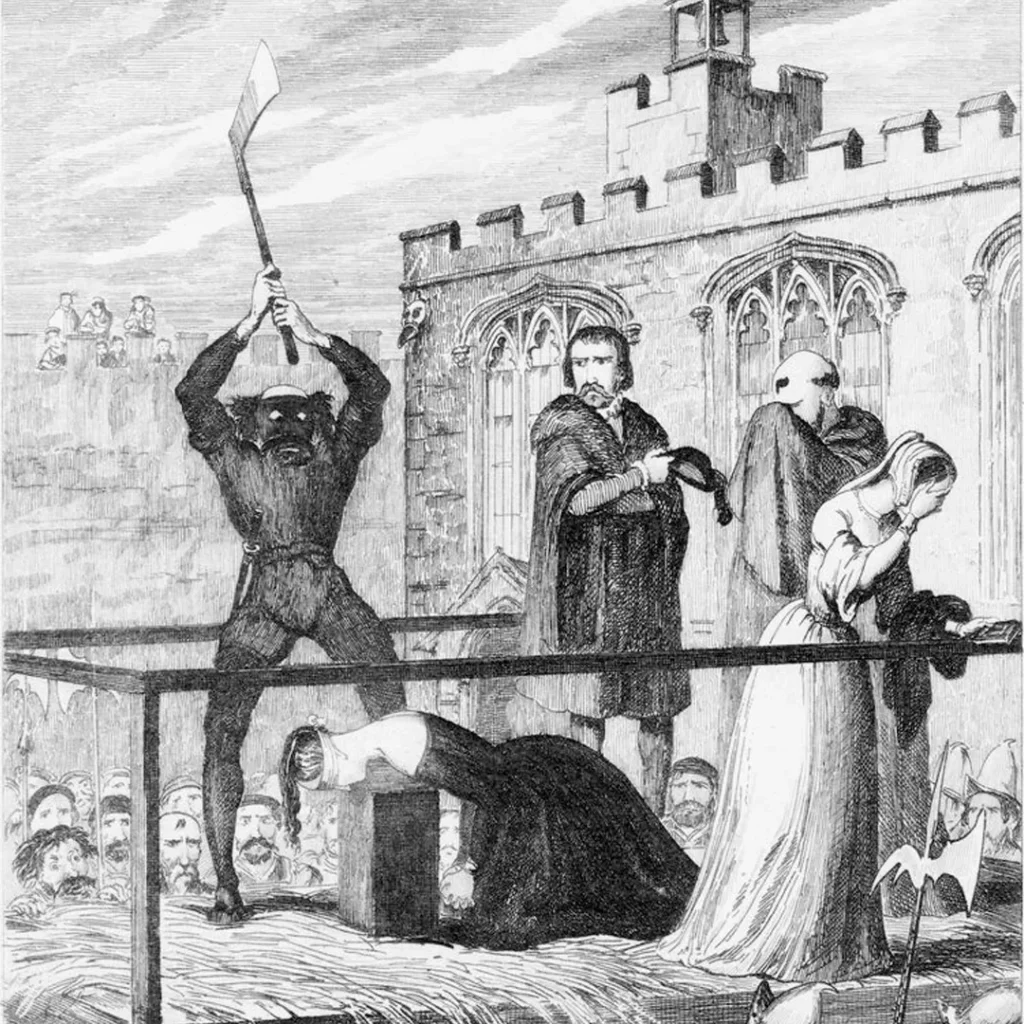
Margaret Pole’s execution was particularly horrific. According to later accounts, the executioner was inexperienced and repeatedly struck her around the head and shoulders rather than severing her neck cleanly. The precise details are debated, but the story has become one of the most infamous examples of a botched execution in English history.
By contrast, Anne Boleyn, condemned for treason and adultery in 1536, requested that her execution be performed by a renowned French swordsman, who travelled from Calais specifically for the occasion. It was a rather more specialised service than the usual work of an English headsman.
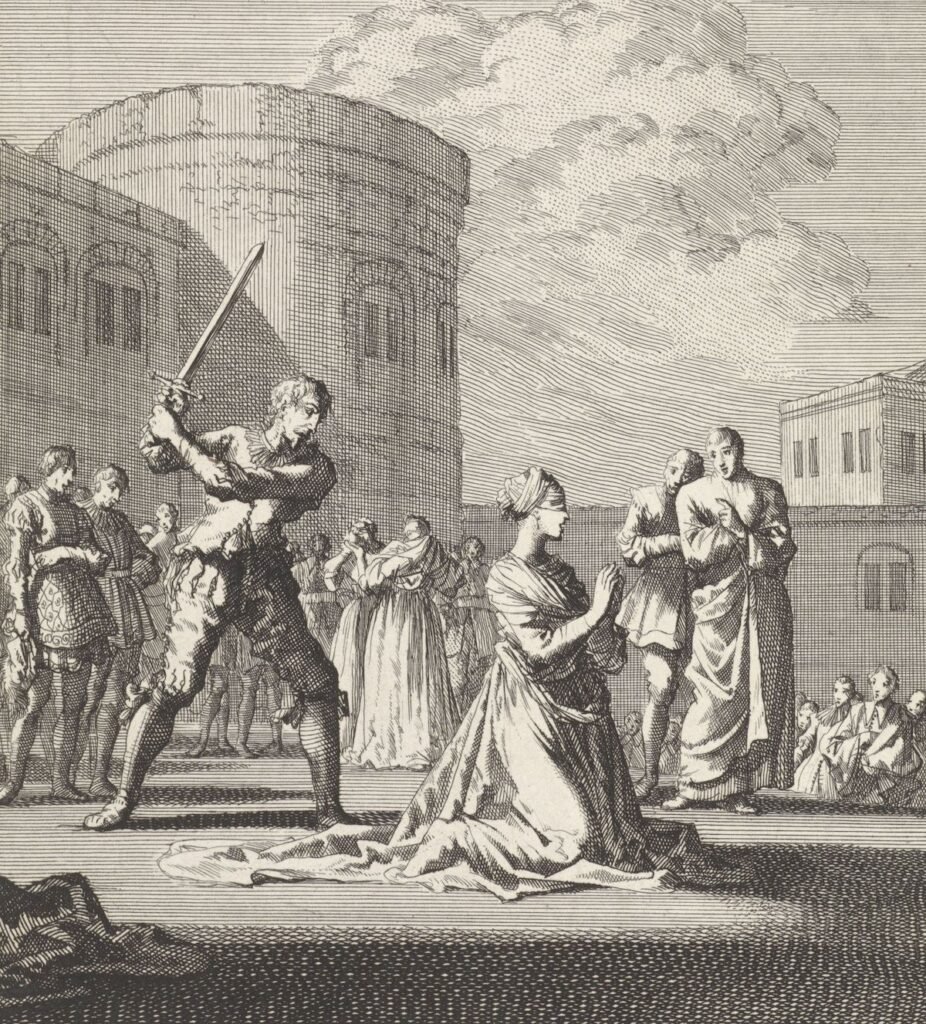
The Tower’s association with executions continued well beyond the Tudor period. In 1941, German spy Josef Jakobs was shot by firing squad at the Tower of London during the Second World War. His execution took place at the Tower’s rifle range, not on Tower Green, and he was the last person executed within the fortress. The contrast between Tudor queens and a Second World War spy is indeed quite extraordinary.
Rebellion and Retribution on Kennington Common
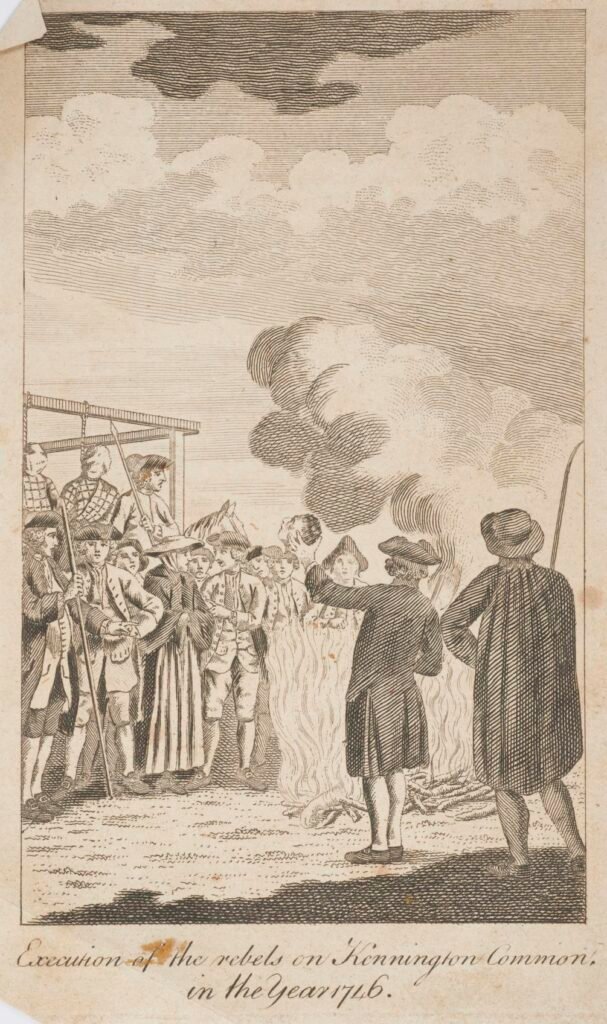
Kennington Common was used for public executions from at least the late seventeenth century. It became an important site for Surrey, and its most significant events included the executions of Jacobite rebels following the uprising of 1745.
On 30 July 1746, nine men associated with the Manchester Regiment were executed there for treason. They were subjected to the punishment of hanging, drawing and quartering, the full and particularly brutal penalty for high treason. One of the men was Colonel Francis Towneley, whose head was later displayed at Temple Bar.
An earlier case connected with the common was that of Sarah Elston, who was burned at the stake on 24 April 1678 after being convicted of murdering her husband, Thomas Elston. The case is intriguing because contemporary accounts do not tell quite the same story.
One pamphlet, A Warning for Bad Wives, describes her husband beating her and presents the fatal stabbing with a pair of scissors as an accident. According to the account, Elston claimed that she had held the scissors out to defend herself and that her husband had run into them. Another version describes her as having deliberately stabbed him. The pamphlets were written to sell a story and promote a moral lesson, rather than to provide an impartial account of domestic life in seventeenth-century Southwark.
Her reported final words and behaviour were also shaped by the expectations of the time. The pamphlet portrayed her as repentant and submissive, warning other wives to obey their husbands. When the fire was lit, it claimed that she gave two or three “lamentable shrieks” before falling silent. Whether every detail is accurate is impossible to establish, but the account offers a disturbing glimpse of how the execution of a woman could be turned into a public lesson about obedience as well as a punishment for murder.
The last recorded execution on Kennington Common was that of William Badger in 1799, who was convicted of forgery. By then, the common’s role as an execution ground was drawing to a close, although its history as a place of public punishment was far from forgotten.
Newgate: The Last Public Spectacle
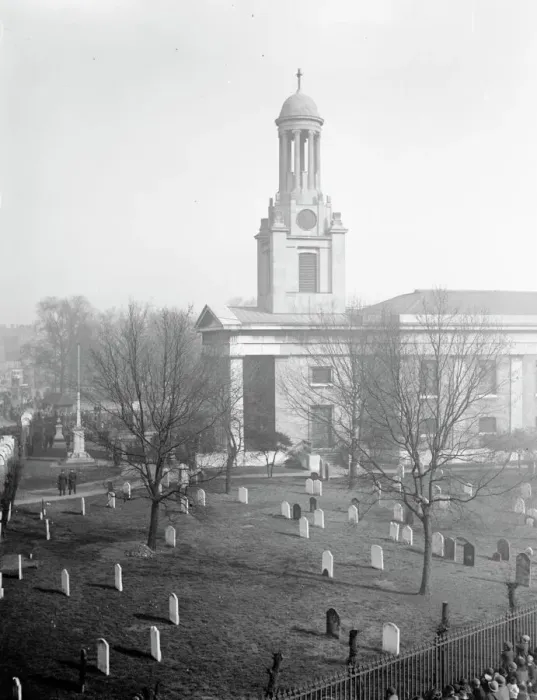
The first references to Newgate Prison date back to 1189. From its earliest years, the prison held people awaiting trial or punishment, including some of London’s most serious offenders. By the fourteenth century, Newgate had acquired a particularly dreadful reputation because of the appalling conditions in which prisoners were kept and the brutality of the prison’s guards. Disease, overcrowding and poor sanitation were recurring problems. The prison was feared by those sent there and hated by many Londoners, who repeatedly attacked it during periods of unrest.

The open space outside Newgate became London’s principal location for public executions in 1783, following the abandonment of Tyburn. A specially constructed gallows allowed the executioner to hang several condemned prisoners at once, sometimes as many as ten. Executions drew thousands of spectators, occasionally estimated at up to 40,000 people, packed into the surrounding streets, taverns and windows of neighbouring buildings.
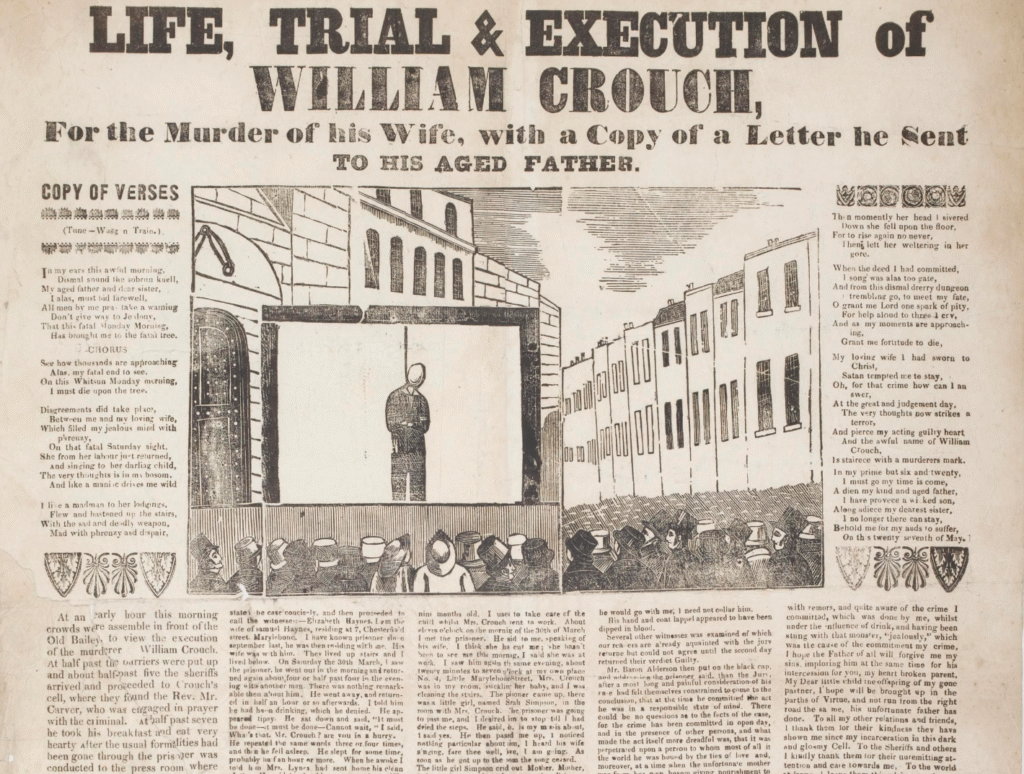
Execution broadsides were another prominent feature of these morbid spectacles. Cheap printed sheets describing the crime, trial, last words and execution were sold to the crowd. They were effectively souvenirs of public death, allowing onlookers to take home a printed account of what they had just watched. The London Museum holds several examples in its collection, including broadsides from Newgate executions.
The final public execution at Newgate, and the last public execution in Britain, took place on 26 May 1868. The condemned man was Michael Barrett, an Irish Fenian convicted for his involvement in the Clerkenwell prison explosion. His execution took place in a changing London: the Metropolitan Railway had opened in 1863, and spectators travelled on the Underground to watch him die. A modern transport system was now carrying people to one of the last public spectacles of state killing. Progress, apparently, came in several forms.
Following Barrett’s execution, the gallows were moved permanently inside the prison, where executions continued away from public view. Newgate finally closed its doors in 1902 and was demolished in 1904. The Old Bailey now occupies the site.

A Gallows Above the Gate
Now the site of Newington Gardens, close to Harper Road, Horsemonger Lane Gaol was the principal execution site for Surrey. The prison opened in 1799, and 126 people were publicly executed there. The gallows were erected on the roof of the prison gatehouse, making proceedings visible to enormous crowds gathered outside. The prison’s gallows could accommodate seven condemned people simultaneously, a capacity put to use on two separate occasions in 1803.
Horsemonger Lane continued to carry out executions in private after public hangings were abolished in 1868. Five people were hanged behind its walls between 1868 and 1877, before the prison was eventually demolished in 1880.
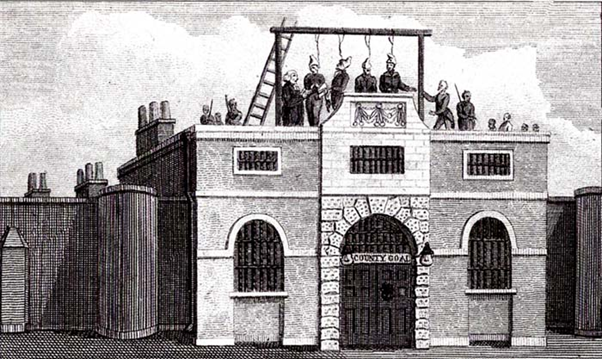
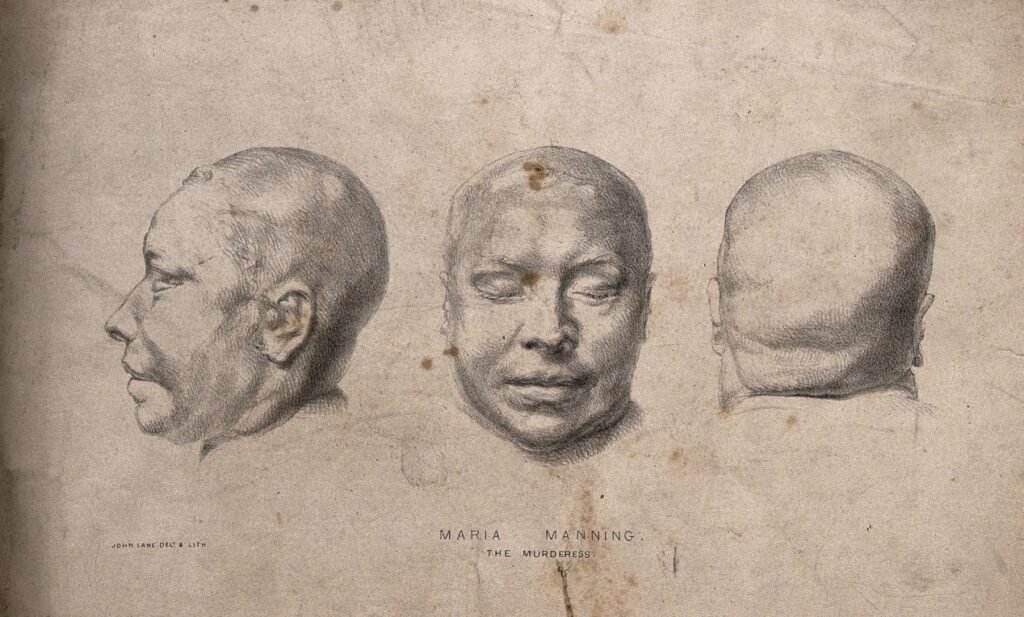
One of the most notorious cases linked to the site was that of Frederick and Maria Manning, convicted of murdering Maria’s lover, Patrick O’Connor, and burying his body beneath the kitchen floor of their home. They were hanged together on 13 November 1849. Their execution attracted vast crowds, with estimates ranging from 30,000 to 50,000 people. Charles Dickens was among the spectators and was so disgusted by the behaviour of the onlookers that he wrote to The Times, describing the scene as one of horror and arguing that public executions should be abolished. Maria Manning also became a literary reference: Dickens is thought to have drawn on her when creating Mademoiselle Hortense in Bleak House.
The execution of Margaret Waters, also known as Mary Waters, is another harrowing story connected with Horsemonger Lane. Waters was a so-called “baby farmer”, a woman paid by mothers who were unable to care for their children and wanted someone to take them in. Some baby farmers provided genuine care, but the practice was also open to exploitation, particularly when children were accepted for a one-off payment and then neglected.
In 1870, Waters advertised that she would take in and adopt unwanted babies. One of the people who responded was the grandfather of a baby boy, John Walter Cowen. He arranged for the child to be handed over to Waters in return for payment. However, growing suspicious of the woman’s subsequent behaviour, he eventually alerted the police.

When Sergeant Richard Relf investigated the house in Brixton where Waters lived with her sister Sarah Ellis, he found nine babies. Several were severely malnourished and had been given opium; five were reportedly in a dying condition. The investigation raised suspicions that Waters might have been responsible for other infant deaths, but she was tried and convicted for the murder of one child, John Walter Cowen.
Waters was hanged privately at Horsemonger Lane on 11 October 1870. Her sister, Sarah Ellis, received a sentence of 18 months’ hard labour. The case caused considerable public outrage and helped prompt the Infant Life Protection Act of 1872, which introduced registration requirements for people taking in infants for payment. The law did not put an end to baby farming or the abuse of children, but the case exposed the dreadful consequences of an arrangement that had previously operated with little oversight.
Three Tides at Execution Dock
Wapping is undoubtedly one of the most atmospheric locations in this collection. The area has been associated with maritime trade for centuries. Its origins may reach back to Anglo-Saxon times, when much of the surrounding land consisted of marshes. During the sixteenth century, this relatively rural settlement, situated outside the old city walls, gradually developed into a busy riverside neighbourhood dominated by inexpensive lodgings for sailors, taverns, brothels and warehouses. It was a poor and often dangerous part of London.
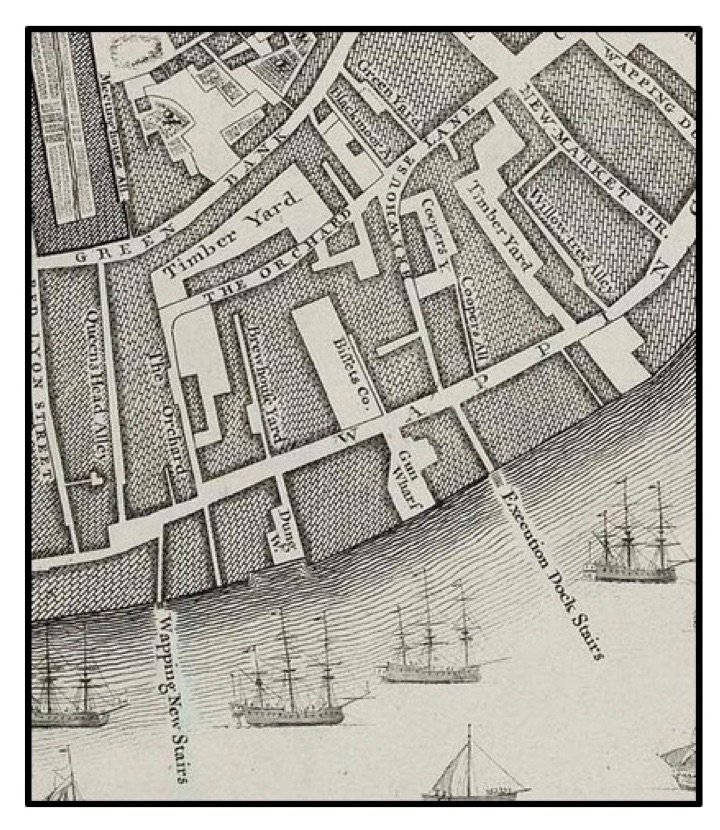
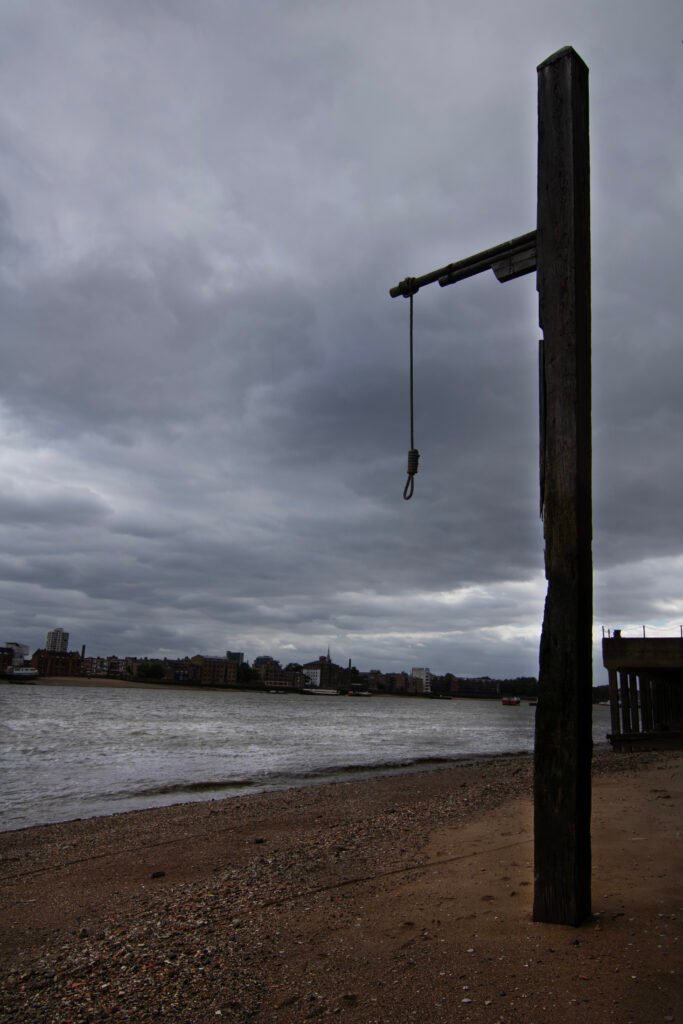
From the eighteenth century onwards, Wapping became an important part of London’s expanding port district, which played a central role in maritime trade with the various colonies of the British Empire. As shipping and trade expanded, the Admiralty courts dealt with crimes committed aboard vessels, including piracy, mutiny and murder. Execution Dock, situated on the banks of the Thames at Wapping, became the place where people convicted of such offences were hanged.
A particular custom was associated with these executions. Traditionally, after being hanged, the condemned person’s body was secured near the low-water mark and left there until three successive tides had washed over it. The practice appears to have died out by the late eighteenth century. In some cases, the bodies were subsequently placed in iron cages and suspended at prominent locations along the Thames, serving as warnings to sailors entering and leaving London’s port. The Thames was not merely the setting for the punishment, but part of the message being sent to anyone tempted to turn to piracy.
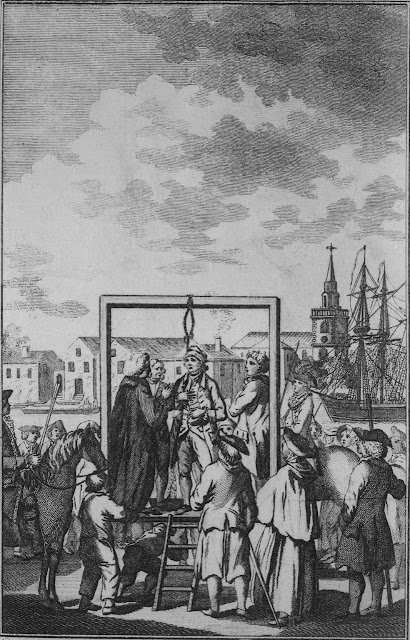
The best-known pirate executed at Wapping was Captain William Kidd, who was hanged at Execution Dock on 23 May 1701 after being convicted of piracy and murder. His execution did not go smoothly: the rope broke during the first attempt, and he had to be hanged again. Apparently, even executioners were not immune to making mistakes at work from time to time. After his death, Kidd’s body was covered in tar and placed in an iron gibbet at Tilbury, where it was left on display as a warning to passing ships.
The Gallows Behind the Walls
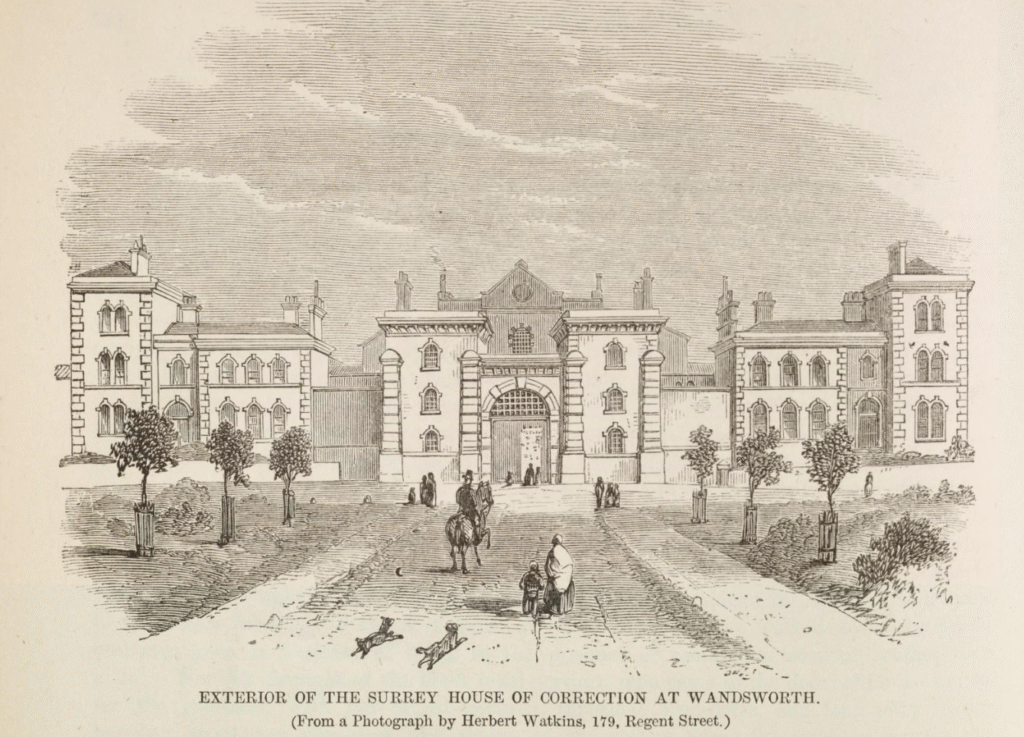
As public executions disappeared from the streets in 1868, the gallows moved behind prison walls. Wandsworth became one of London’s principal execution prisons, taking over the role previously held by Horsemonger Lane for Surrey. The prison opened in 1851 as the Surrey House of Correction and remains in use today.
Wandsworth was built according to the Victorian principle of the separate system, with a central hub and wings radiating outwards. The intention was to keep prisoners isolated from one another and under close supervision. When it opened, it contained individual cells for around 700 inmates, each originally equipped with its own private toilet. These were removed after 1870, reportedly because the early plumbing was unreliable and prone to blockages. Victorian prison reform had its limits, particularly when it came to personal convenience.
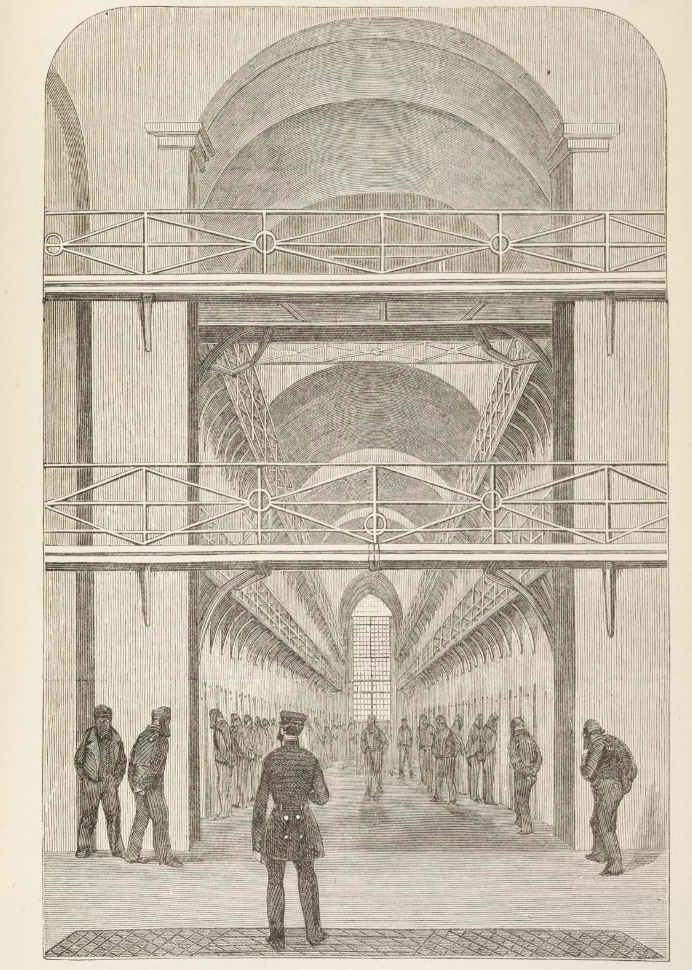
Executions began at Wandsworth in 1878 and continued until 1961. In total, 135 people were put to death there, making it one of England’s most heavily used execution prisons during the late nineteenth and twentieth centuries. The first person executed there was Thomas Smithers, hanged on 8 October 1878 for the murder of Amy Judge in Battersea.
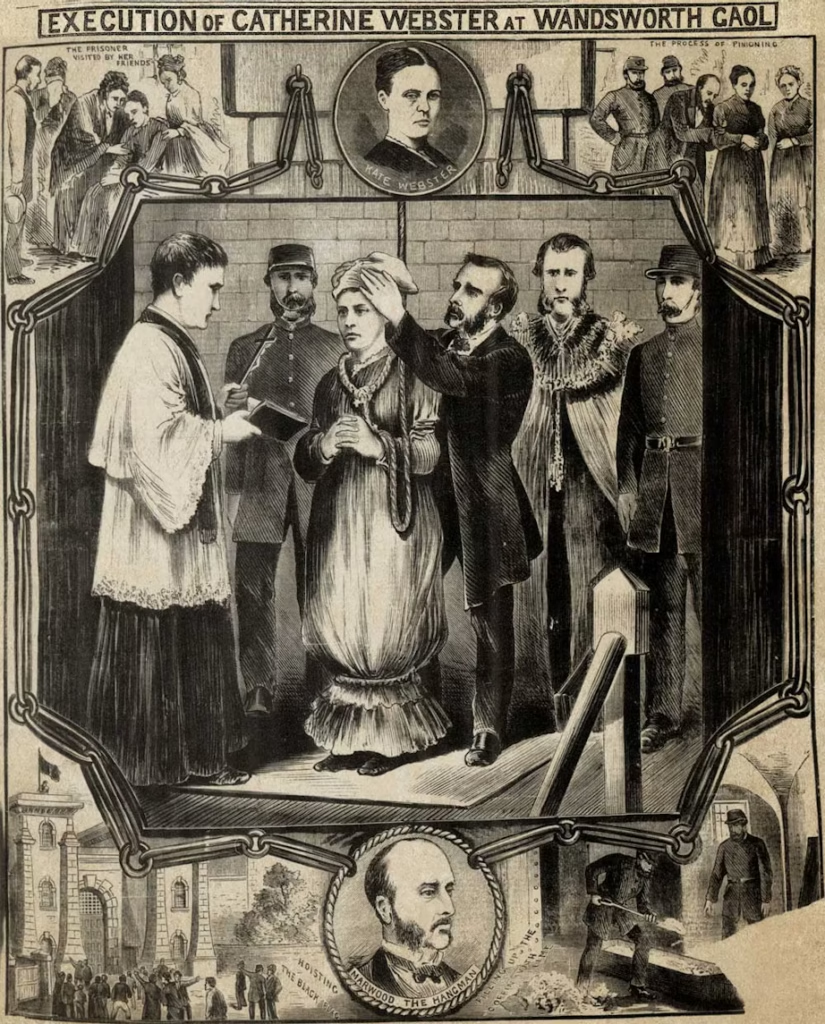
The only woman executed at Wandsworth was Kate Webster, who was hanged in 1879 for the murder of her employer, Julia Thomas. Her case had attracted considerable attention because of the disturbing circumstances surrounding the discovery of her victim’s remains. Webster dismembered Thomas’s body and boiled the remains in a laundry copper before disposing of them in the Thames. The victim’s head remained missing for more than 130 years, until a skull was discovered during building work in Richmond in 2010.
Wandsworth was also the site of executions of several high-profile figures convicted of treason or murder. William Joyce, better known as Lord Haw-Haw, was hanged there in 1946 for treason after broadcasting Nazi propaganda during the Second World War. Derek Bentley was also executed there in 1953, in one of the most controversial cases in modern British legal history.
The final execution at Wandsworth took place on 8 September 1961, when Henryk Neimasz was hanged. By then, the public spectacle of Tyburn was a distant memory. The condemned were no longer paraded through the streets or watched by thousands; the process had become a tightly controlled procedure conducted behind prison walls.
The Castle and Its Condemned Women
Holloway Prison opened in 1852 as a mixed-sex gaol and house of correction. Its grand Victorian architecture, with imposing walls, turrets and a formidable gatehouse, earned it the nickname “The Castle”. It was designed to look every bit as intimidating as the institution it housed. The original building followed the radial prison design, with wings extending from a central point to make prisoners easier to supervise and keep apart.
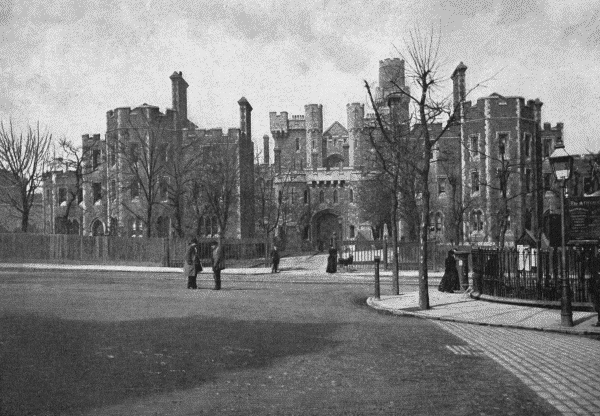
Holloway initially held both men and women, but became a women-only gaol in 1903. It soon acquired a questionable reputation as one of Britain’s best-known prisons. More than 300 suffragettes were imprisoned there during the campaign for women’s right to vote. Many went on hunger strike to protest against their treatment as ordinary criminals rather than political prisoners, and some were forcibly fed. The prison also held a number of other well-known inmates over the years, including Oscar Wilde before his trial, and Oswald Mosley and his wife Diana during the Second World War.
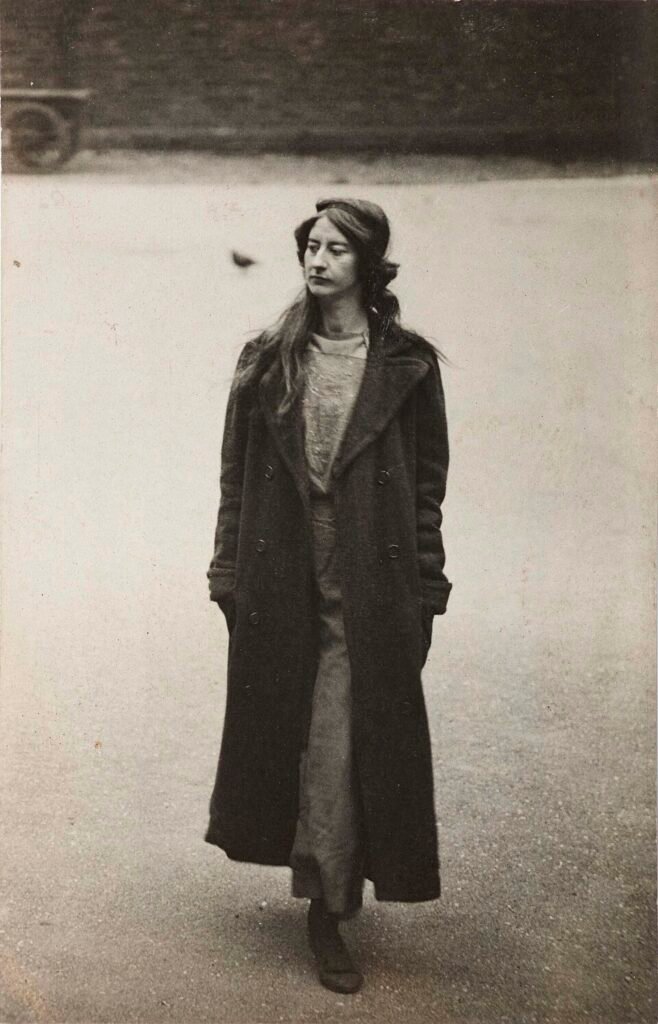
Holloway’s reputation was not built solely on its political prisoners. It also became the place where five women were executed between 1903 and 1955, in four separate executions. The first were Amelia Sach and Annie Walters, convicted of murdering a baby in their care in the notorious “baby farming” case of 1903. They were suspected of involvement in other infant deaths, although they were convicted of the murder of one child. Their executions attracted considerable attention, and crowds gathered outside the prison to listen for the bell announcing that the hangings had taken place.

The final woman to be executed at Holloway was Ruth Ellis, hanged on 13 July 1955 for the murder of her lover, David Blakely. Her case also generated widespread public interest and became one of the most controversial executions of the twentieth century. Ellis was the last woman to be executed in Britain. Her case helped strengthen public opposition to capital punishment, although the death penalty for murder was not permanently abolished until 1969.
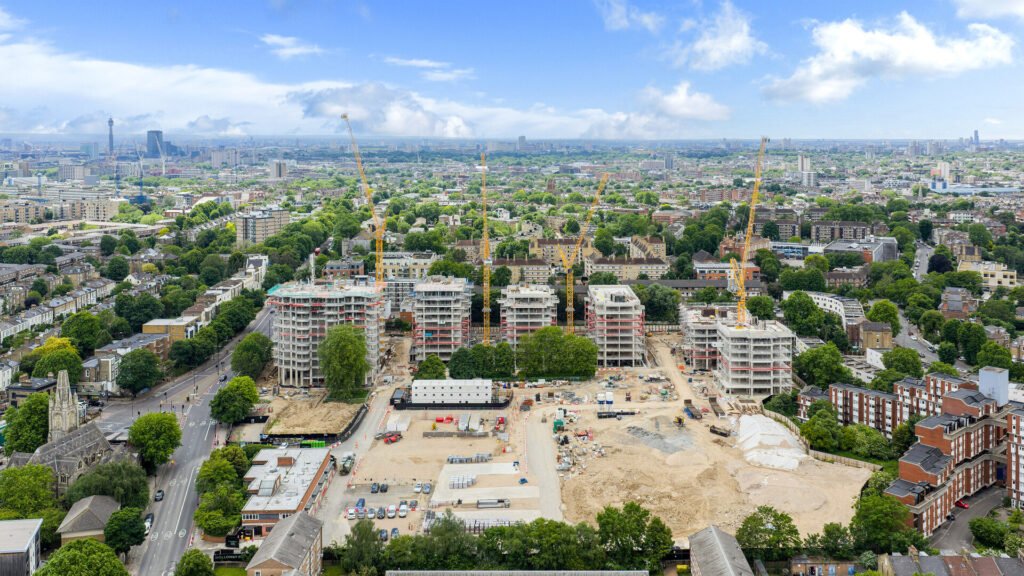
The original Victorian prison was demolished and rebuilt during the 1970s and 1980s. Holloway finally closed in 2016, after more than 160 years of operation. The site is now being redeveloped, and little remains of the imposing building that once dominated the neighbourhood.
A City Built on Its Gallows
By the eighteenth and nineteenth centuries, the spectacle of public executions was increasingly at odds with a society that liked to think of itself as civilised. In 1868, the crowds were finally sent home and the gallows moved behind prison walls. The spectacle disappeared, but for as long as capital punishment remained legal, the principle was much the same: the state deciding who should die, and making the arrangements accordingly.
Today, many of these former execution grounds are parks, busy roads, market squares or redeveloped prison sites. People walk their dogs, go shopping and commute to work in places where, centuries ago, crowds gathered to watch other people die. London has always been rather good at building over its past. Sometimes, though, it is worth remembering what lies beneath the paving stones.
Happy Halloween!
Discover more from London Macabre
Subscribe to get the latest posts sent to your email.